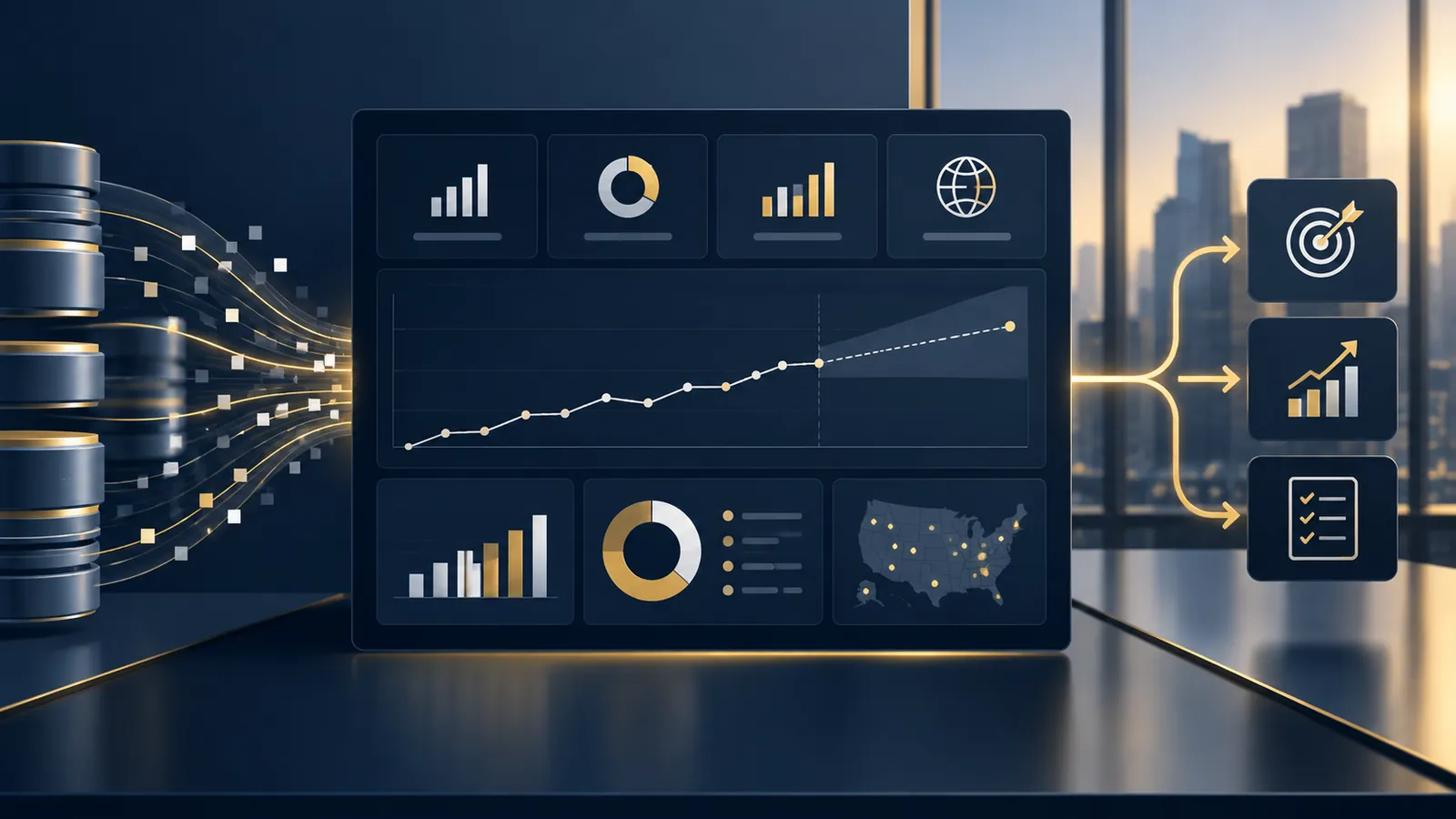
Businesses today rarely suffer from a lack of data. The bigger challenge is knowing what to do with it.
Sales platforms, websites, advertising channels, customer databases, operational systems, and financial reports can generate thousands of data points every day. Yet having more data does not automatically lead to better decisions. Business analytics helps bridge that gap.
Data Is Not the Same as Insight
A dashboard can tell you that revenue declined by 8%, website conversions increased, or customer acquisition costs changed. Those numbers describe what happened.
The more valuable questions often come next: Why did it happen? Which factors contributed to the change? Is the pattern temporary or persistent? What should the organization do next?
This is where analytics moves beyond reporting.
Business analytics combines data preparation, statistical analysis, visualization, modeling, and business context to turn raw information into evidence that can support decisions.
Start With the Business Question
Effective analytics should not begin with a tool. It should begin with a question.
A company might want to understand why customer retention is declining, which marketing channels generate incremental value, how demand may change over the next quarter, or which operational factors are driving costs.
The analytical approach should then be selected around that problem.
Depending on the question, this could involve exploratory data analysis, KPI development, regression analysis, forecasting, segmentation, predictive modeling, visualization, or simulation.
The objective is not to use the most sophisticated model available. It is to use an appropriate method that produces useful information for the decision being made.
Reporting Is Only the Beginning
Dashboards remain an important part of analytics.
Tools such as Tableau and Power BI can transform large datasets into accessible visualizations and allow decision-makers to monitor KPIs efficiently.
But visualization is most valuable when it leads to investigation.
If a KPI changes unexpectedly, analytics can help move from:
“What happened?”
to:
“Why did it happen, what may happen next, and what can we do about it?”
That progression—from descriptive to diagnostic, predictive, and eventually prescriptive thinking—is where analytics becomes particularly valuable.
Different Problems Require Different Methods
There is no universal analytics solution.
A marketing team may need attribution analysis, customer segmentation, or Marketing Mix Modeling.
A healthcare organization may be interested in utilization, costs, outcomes, or cost-effectiveness.
An operations team may need forecasting, scenario analysis, or simulation.
Another organization may simply need cleaner databases, reliable KPIs, and a dashboard that people can actually use.
The technology matters, but the analytical reasoning behind it matters more.
Where Economics Fits In
Analytics is ultimately connected to decision-making under constraints.
Organizations have limited budgets, limited time, competing priorities, and uncertain outcomes. Economics provides a useful framework for thinking about trade-offs, incentives, opportunity costs, and resource allocation.
Combining this perspective with statistical and computational methods makes it possible to approach analytics not simply as a technical exercise, but as a decision-support discipline.
From Data to Decisions
The purpose of business analytics is not to produce more charts, reports, or models.
It is to reduce uncertainty.
Sometimes that means identifying an overlooked pattern. Sometimes it means building a forecasting model. Sometimes it means discovering that the available data does not support the conclusion an organization expected.
All three can be valuable outcomes.
The strongest analytics work connects three things: the right business question, the right analytical method, and a result that decision-makers can actually use.
That is the difference between simply having data and using data strategically.
Need help turning your data into better decisions?
UAD Consulting provides analytics, modeling, visualization, and decision-support services built around real business problems.
Explore ServicesGet in Touch