Ubeyd A. Dincer
My background combines economics and business analytics, two disciplines that shape how I approach analytical problems. Studying Economics taught me to think about incentives, trade-offs, resource allocation, and decision-making, while graduate training in Business Data Analytics added the technical tools to work with data, measure performance, build analytical models, and translate evidence into practical decisions.
Professionally, that perspective developed through industry experience in marketing analytics, where I worked with digital performance data, campaign measurement, web analytics, and business reporting using tools such as SQL, Python, GA4, GTM, BigQuery, Adobe Analytics, and Snowflake. The experience reinforced an important principle: useful analytics is rarely about producing more metrics—it is about identifying which information actually matters to a business decision.
That analytical work later expanded into applied healthcare research, where the questions became increasingly complex. Working across different domains has strengthened my ability to learn unfamiliar business contexts, structure ambiguous problems, connect multiple data sources, and select analytical methods based on the decision at hand rather than relying on a single tool or methodology.
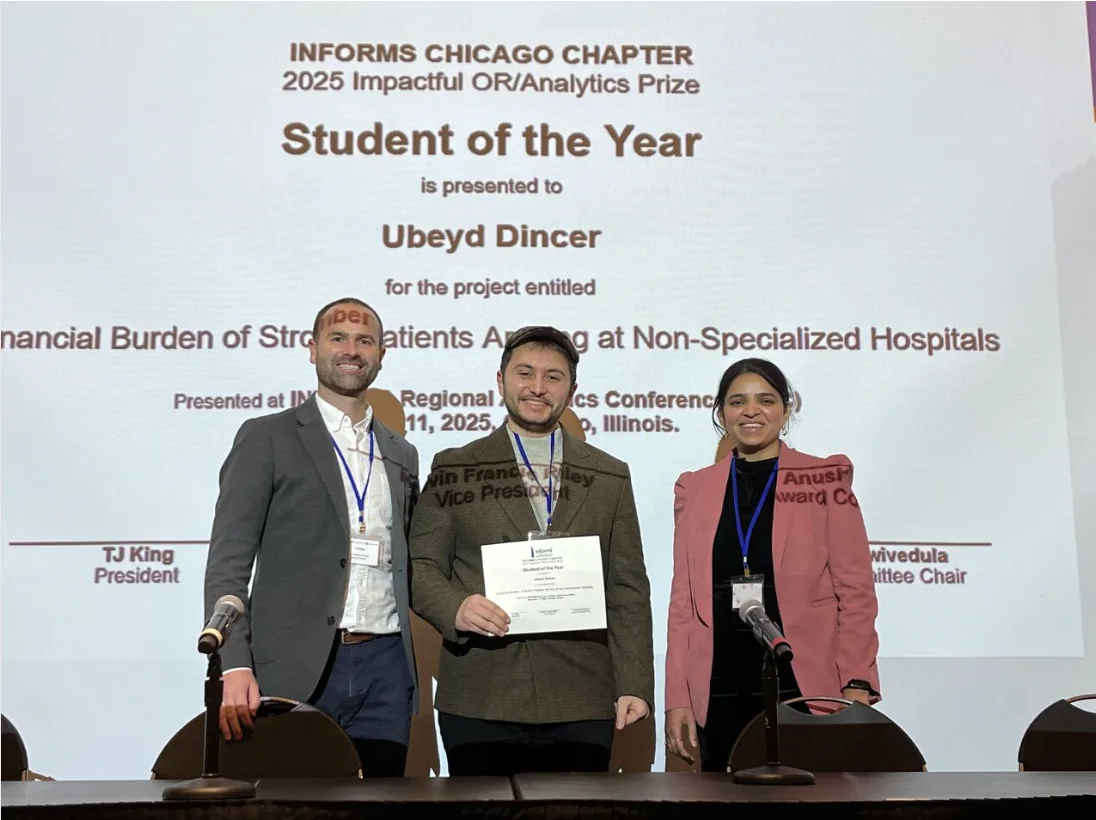
One example is my research on the Financial Burden of Stroke Mis-triage, conducted in Dr. Samie Tootooni's research lab at Loyola University Chicago's Parkinson School of Health Sciences and Public Health. The study, conducted in collaboration with Michael T. Saban, M.Sc., Alireza Kasaie, Ph.D., Adnan Hossain, M.A., Daniel Heiferman, M.D., Talar Markossian, Ph.D., and Samie Tootooni, Ph.D., examined national emergency department data across more than 32 million encounters and 993 hospitals. The analysis connected patient-level clinical and utilization data with hospital capabilities, transfer patterns, and cost information to evaluate the broader economic impact of potentially avoidable transfers. This work was recognized by the INFORMS Chicago Chapter with the 2025 Student of the Year Award and Impactful OR/Analytics Prize.
These experiences shape how I approach analytics today. I view data engineering, visualization, statistical analysis, predictive modeling, simulation, marketing measurement, and decision modeling as parts of a broader analytical process rather than isolated technical services. The objective is to understand the underlying business question, establish reliable evidence, communicate uncertainty clearly, and help translate analysis into decisions that can actually be used.
Have a Question Worth Exploring?
Let’s discuss how analytics can help clarify a business or research decision.