Operational Performance & Process Improvement
Manufacturing Quality & Supply Chain Case
A data-driven process improvement assessment focused on supplier quality, operational efficiency, process standardization, and measurable business performance.
The Challenge
A manufacturing company was experiencing declining raw-material quality, inconsistent receiving and inspection practices, supplier communication gaps, and low adoption of a new procurement and warehouse management system.
These issues contributed to low first-time pass rates, rework, receiving errors, customer complaints, and increasing operational costs. The business objective was to improve first-time pass performance while creating a more reliable and measurable procurement and warehouse process.
Approach
The assessment combined process mapping, root-cause analysis, operational benchmarking, gap analysis, performance measurement, and financial impact estimation to move from diagnosis to an actionable improvement plan.
Root Cause & Process Analysis
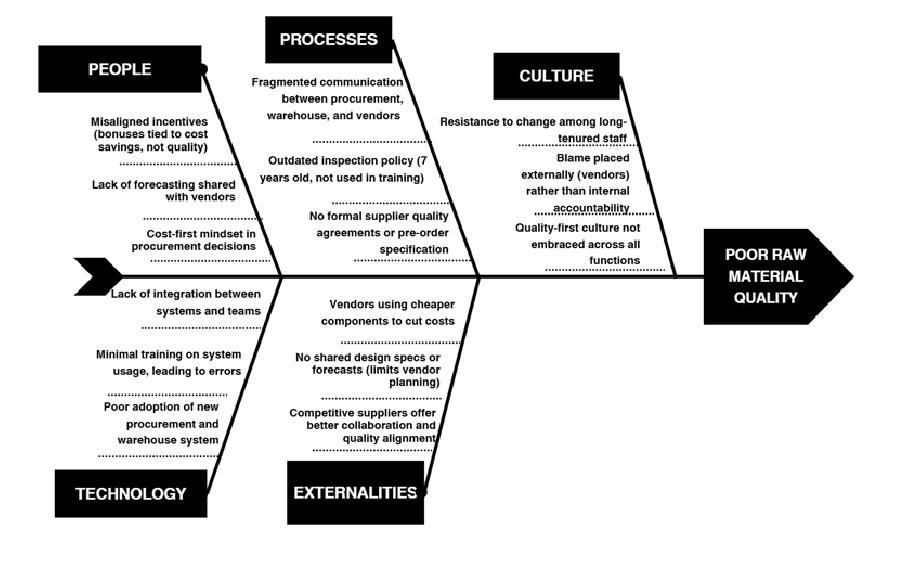
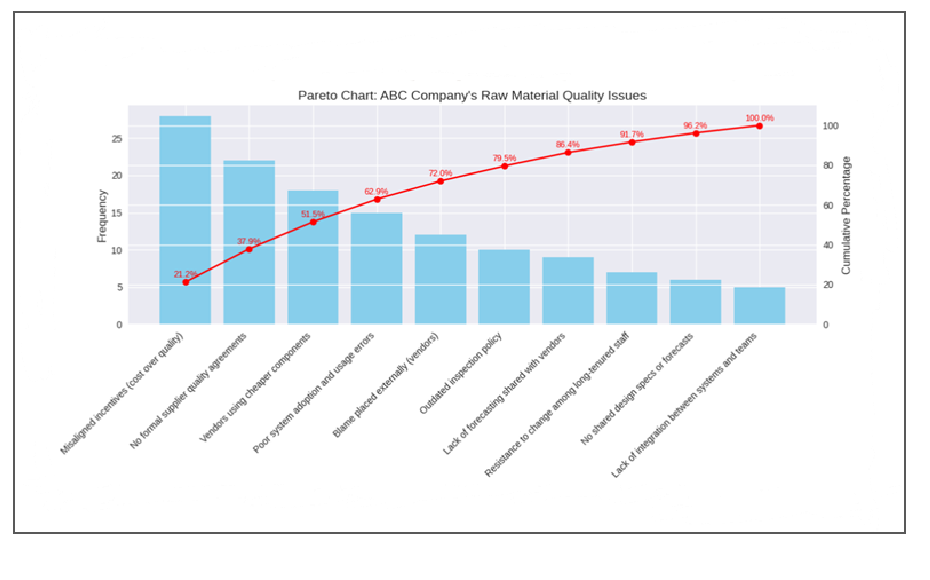
The analysis used cause-and-effect (Fishbone) analysis, process flow mapping, Pareto analysis, As-Is / Should-Be process analysis, and gap analysis.
Key Findings
Supplier Quality
Inconsistent supplier quality standards and purchasing incentives created variation in incoming materials.
Process Standardization
Receiving and inspection procedures lacked consistent standards and training.
Supplier Communication
Forecasts, specifications, and quality expectations were not consistently shared with suppliers.
System Adoption
The procurement and warehouse management system was underutilized, contributing to process and receiving errors.
Cross-Functional Alignment
Procurement, warehouse, manufacturing, and quality functions lacked shared accountability for quality outcomes.
Improvement Strategy
Supplier Quality Assurance
Establish measurable supplier quality standards, scorecards, and formal supplier quality agreements.
Standardized Inspection
Update receiving and inspection protocols and train warehouse employees on consistent procedures.
Supplier Information Sharing
Improve the exchange of forecasts, specifications, and quality requirements with strategic suppliers.
Cross-Functional Quality Management
Create a cross-functional improvement team connecting procurement, warehouse, manufacturing, quality, and finance.
Performance Measurement
The proposed framework connects operational improvements to measurable KPIs.
Quality
First-Pass YieldSupplier Defect Rate
Customer Claim Rate
Return-to-Vendor Ratio
Delivery
On-Time DeliveryLead-Time Adherence
Schedule Reliability
Cost
Cost of Poor QualityProcurement Cost per Acceptable Unit
Rework Cost
Collaboration
Forecast AccuracySupplier Communication
Specification Transparency
Projected Business Impact
Projected results based on scenario assumptions developed for the case analysis; they do not represent realized client outcomes.
Business Value
The project demonstrates how process analysis can connect operational problems to measurable business outcomes. Rather than treating supplier defects as an isolated quality issue, the assessment linked procurement incentives, supplier management, warehouse procedures, system adoption, organizational alignment, and performance measurement into a single improvement framework.
Methods & Tools
Graduate-level applied performance improvement case study based on a simulated manufacturing organization.