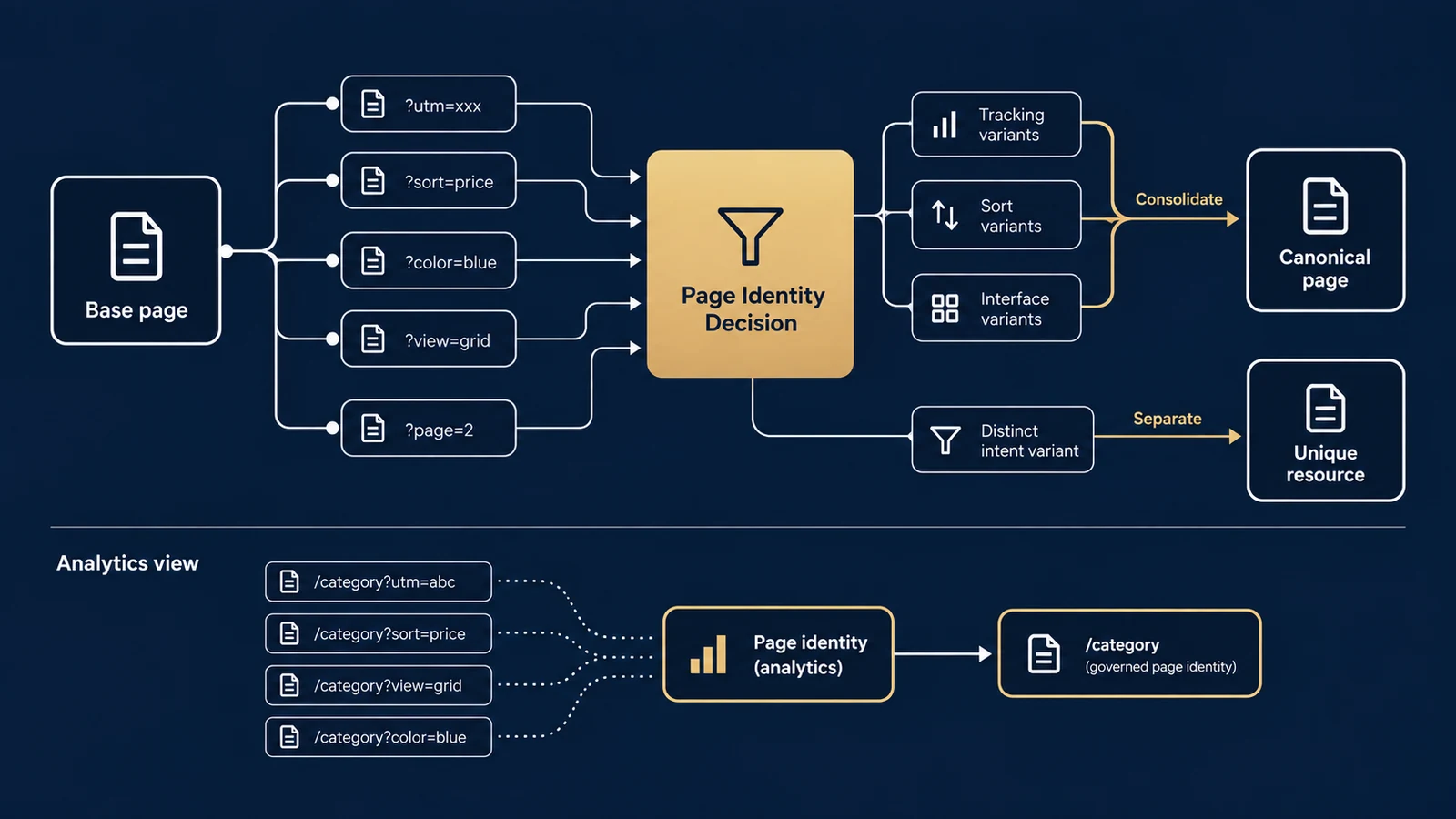
A website has one category page: /analytics-services. Then filters are added: ?industry=healthcare, ?industry=retail, ?sort=price, ?utm_source=linkedin, and ?view=grid.
Technically, the site can now expose multiple URLs. But how many pages does it actually have?
That distinction matters. A URL variation can represent a genuinely different resource, a useful search landing page, a temporary interface state, a tracking parameter, a sorting preference, or effectively the same content under another address.
Treating every URL as a separate page can create unnecessary duplication. Collapsing every variation into one canonical page can also be wrong when a variation serves a distinct user need.
The useful question is therefore not:
“Does this URL contain a parameter?”
It is:
“Does this URL represent a distinct resource that deserves independent discovery, indexing, measurement, and maintenance?”
That turns canonicalization from a technical checkbox into an information-architecture decision.
URL Is Not the Same as Content
Consider /reports?sort=newest and /reports?sort=oldest. The order changes, but the underlying collection may not.
Now consider /healthcare-analytics and /marketing-analytics. These pages could contain different services, examples, terminology, case studies, and search intent. They may deserve separate identities.
The decision cannot be made by URL syntax alone.
Google describes canonicalization as the process of selecting a representative URL from a group of duplicate or very similar pages. Sorting and filtering functions are common reasons duplicate URLs can exist. The architectural task is to determine which variations are duplicates and which represent meaningful entities or intents.
The Five-Question URL Test
1. Does the User Intent Change?
Suppose an ecommerce category has /laptops and /laptops?use=gaming. Someone searching for gaming laptops may have a meaningfully different need from someone searching broadly for laptops.
Now compare /laptops?sort=price-low. The sorting preference changes presentation, but probably not the underlying search intent.
2. Does the Main Content Change Substantially?
Changing one button state is not the same as creating a new page. Ask whether the variation changes primary items, explanatory copy, headings, comparisons, FAQs, examples, or recommendations. If two URLs contain essentially the same main content, separate indexing may create little additional value.
3. Would You Intentionally Link to It?
Imagine writing another article. Would you naturally say, “See our healthcare analytics services,” and link directly to a healthcare-specific page? That suggests durable informational value. Would you naturally link to ?sort=descending&view=compact? Probably not.
4. Can You Maintain It?
Creating indexable pages creates obligations: accurate content, stable routing, internal links, canonical consistency, metadata, analytics, sitemap management, and updates. Generating 50,000 technically distinct URLs is easy. Maintaining 50,000 useful resources is not.
5. Can You Measure It Clearly?
If multiple URL variants represent the same resource, analytics can fragment. Instead of seeing one service page with 10,000 sessions, reporting may split the total across tracking, view, sort, and referral variants.
SEO architecture and analytics architecture are connected.
A Practical Classification Framework
A useful starting point is to classify URL variations into four groups.
| URL variation | Typical purpose | Separate indexable page? |
|---|---|---|
| Tracking parameter | Attribution and measurement | Usually no |
| Sorting/display state | Interface preference | Usually no |
| Functional filter | Narrow current dataset | Depends |
| Distinct intent/resource | Durable user need | Often yes |
This is a decision framework, not a universal rule. The important category is Depends. Filters can sometimes become valuable standalone resources.
Example: When a Filter Deserves Promotion
Suppose a consulting site has /case-studies and users can filter by industry. Initially, those filters merely hide and show cards.
Later, the business develops substantial healthcare-specific content: several healthcare case studies, healthcare analytics methodology, health economics examples, dedicated service descriptions, and dedicated FAQs.
At that point, healthcare may no longer be just a filter. It may deserve a durable page such as /healthcare-analytics.
This is an architectural promotion:
interface state → information resource
The new page should not simply duplicate the filtered card list. It should justify its independent existence.
A Simple Page Independence Score
Teams can formalize the discussion by scoring a candidate page from 0 to 2 across five dimensions. This is not an industry standard; it is a decision aid.
| Dimension | 0 | 1 | 2 |
|---|---|---|---|
| Search/user intent | Same | Partially distinct | Clearly distinct |
| Main content | Nearly identical | Some unique content | Substantially unique |
| Internal-link value | Rarely useful | Occasionally useful | Natural destination |
| Persistence | Temporary state | Moderately stable | Durable resource |
| Business value | Little independent value | Supporting value | Clear independent value |
| Candidate | Intent | Content | Link value | Persistence | Business value | Total |
|---|---|---|---|---|---|---|
?sort=newest | 0 | 0 | 0 | 1 | 0 | 1 |
?industry=healthcare | 2 | 1 | 2 | 2 | 2 | 9 |
?view=grid | 0 | 0 | 0 | 1 | 0 | 1 |
A score of 9 does not mathematically prove that the healthcare filter should become a standalone page. The scoring system forces stakeholders to explain why a metric deserves independent identity.
Canonicalization Is Consolidation, Not Deletion
Suppose these URLs expose essentially the same article: /data-quality, /data-quality?utm_source=linkedin, and /data-quality?ref=newsletter. The tracking parameters may be useful for measurement, but they do not necessarily represent different content.
A canonical declaration can indicate that the preferred representative is /data-quality. Google describes rel="canonical", redirects, and sitemap inclusion among signals that can help indicate a preferred canonical URL. Google also notes that its canonical choice can differ from the publisher’s preference.
A canonical tag is not a magic instruction that repairs contradictory architecture. If a site says canonical = A but internally links heavily to B, places B in the sitemap, redirects inconsistently, and serves materially different content on A and B, the implementation sends mixed signals.
Think in Terms of Signal Alignment
For a page intended to be the primary resource, the architecture should ideally align:
- Public URL
- Internal links
- Canonical
- Sitemap
- Structured-data identity
- Open Graph URL
- Analytics normalization
This is why clean URL governance matters. If a site’s preferred article is /decision-thresholds-business-analytics, consistently using that identity is cleaner than alternately treating the clean route and .html as separate destinations.
The objective is not cosmetic URL perfection. It is reducing ambiguity across systems.
Redirect and Canonical Solve Different Problems
Suppose both /article.html and /article exist. If the .html version no longer needs to remain independently accessible, a permanent redirect can consolidate the old address into the preferred address.
A canonical is different. The alternate page can remain accessible while declaring another URL as preferred.
Redirect: “Use the other URL.”
Canonical: “This page exists, but the other URL is the preferred representative.”
Which mechanism is appropriate depends on whether users and systems still need the alternate URL.
Tracking Parameters Need Special Care
Consider /services?utm_source=linkedin&utm_campaign=analytics. The UTM values describe how the visitor arrived. They do not usually describe a different service page.
The useful distinction is:
Acquisition metadata ≠ content identity
The campaign can still be measured while the underlying page retains one canonical identity. This is particularly important when combining web analytics with warehouse data because inconsistent URL normalization can produce inflated page counts and fragmented landing-page reporting.
Worked Analytics Example
| URL | Sessions |
|---|---|
/article | 4,200 |
/article?utm_source=linkedin | 1,500 |
/article?utm_source=email | 900 |
/article?ref=homepage | 600 |
/article?view=reader | 300 |
Total sessions are 7,500 in this simplified example. If these URLs all represent the same content resource, a normalized reporting dimension can map them to /article. This does not mean campaign parameters should be discarded. Store acquisition dimensions separately.
SQL Example: Normalize Page Identity
A warehouse transformation might create a clean path field rather than grouping by the entire URL. The following SQL is illustrative; the placeholder project and dataset do not imply a real source.
SELECT
  REGEXP_EXTRACT(page_location, r'^https?://[^/]+([^?]*)') AS page_path,
  COUNT(*) AS page_views
FROM analytics_events
WHERE event_name = 'page_view'
GROUP BY page_path;
The transformation removes the query string when creating the page-path dimension. Whether that is appropriate depends on the site. If parameters materially change the content, stripping every query string could incorrectly combine distinct resources.
Faceted Navigation Can Create URL Explosion
The problem becomes larger on sites with many combinable filters. Ten brands × eight colors × six sizes × five price bands creates 2,400 theoretical combinations. Add four sort choices and two availability states and the potential states reach 19,200, before parameter order and other interface states.
Not every combination deserves to become a search landing page. Google’s crawl guidance notes that large numbers of duplicate or unnecessary URLs can consume crawling resources and recommends managing URL inventory and consolidating duplicate content where appropriate.
Scale matters. Google also says that smaller sites with relatively few rapidly changing pages generally do not need to focus on crawl-budget guidance. The architecture should match the scale of the actual problem.
Do Not Turn Crawl Budget Into a Universal SEO Explanation
“Crawl budget” is sometimes used to explain almost every indexing issue. That is too broad. For a small consulting site, more likely questions include whether the page is internally linked, in the sitemap, useful and distinct, canonicalized consistently, and returning the correct HTTP status.
Pagination Is Not Duplicate Content by Default
Consider /blog, /blog/page/2, and /blog/page/3. These pages share a template but expose different article sets. If Page 2 is a legitimate archive resource, canonicalizing it back to Page 1 can incorrectly imply that Page 2 is merely a duplicate.
A better architecture can allow Page 1, Page 2, and Page 3 to self-canonicalize, with crawlable links connecting the archive.
Similarity of template does not automatically mean duplication of resource.
Canonicalization Does Not Establish Search Demand
Creating pages such as /analytics-consulting-healthcare, /analytics-consulting-retail, and /analytics-consulting-finance and giving each a self-canonical does not prove users want those pages.
Technical indexability is not evidence of search demand. Search performance can change because of content, links, competition, query demand, site architecture, crawling, indexing, and algorithmic changes. Technical SEO enables clearer discovery and interpretation; it does not create causal certainty about ranking outcomes.
A URL Governance Table
| Pattern | Indexable? | Canonical | Sitemap? | Analytics identity |
|---|---|---|---|---|
/article | Yes | Self | Yes | /article |
/article.html | No separate page | Redirect to /article | No | /article |
?utm_* | No separate content identity | Base resource | No | Base path + campaign dimensions |
?sort=* | Usually no | Depends on architecture | Usually no | Base collection |
/blog/page/2 | Yes | Self | Depends on site convention | /blog/page/2 |
| Durable topic page | Yes | Self | Yes | Own clean path |
Documenting the intended behavior for important URL patterns helps SEO, development, analytics, and content teams implement the same page identity model.
A Decision Tree for New URL Variations
When a new filter or parameter is proposed, ask:
- Intent
- Distinct content
- Persistence
- Maintainability
- Independent page
If the variation does not materially change the resource or user intent, keep it as interface or measurement state. If it does, ask whether it is durable and independently useful, whether the organization can provide unique content, and whether it can maintain the page.
The sequence can be summarized as:
Intent → Distinct content → Persistence → Maintainability → Independent page
Good URL Architecture Is a Data Model
A website is not only a collection of documents. It is also a model of entities and relationships.
A URL tells multiple systems: “This is a resource.” Search engines use that identity while crawling and indexing. Analytics systems use it when grouping behavior. Structured data attaches entities to it. Internal links establish relationships around it. Sitemaps expose it. Social previews reference it.
That is why URL architecture should not be treated as an afterthought. The decision to create another indexable URL is effectively a decision to create another entity in the site’s information model.
The best question is therefore not “Can we generate this URL?” It is:
“Does this deserve to exist as a resource of its own?”
References / Further Reading
Is Your Website Architecture Creating More URLs Than Useful Pages?
UAD Consulting helps organizations connect analytics, measurement, SEO, and data architecture so page identities, reporting, and digital decision systems remain consistent as websites grow.
Explore ServicesGet in Touch