Titanic Survival Prediction with IBM SPSS Modeler
Classification, Clustering & Model Comparison
An applied machine learning project using the Titanic passenger dataset to explore survival prediction through multiple classification and clustering techniques in IBM SPSS Modeler. The workflow was designed to compare alternative modeling approaches within a single visual analytics environment.
Project Overview
The project uses IBM SPSS Modeler to build and compare multiple analytical approaches for understanding passenger survival patterns in the Titanic dataset. A shared data preparation workflow feeds a range of supervised and unsupervised modeling techniques, allowing alternative methods to be explored within the same analytical pipeline.
The visual stream demonstrates how data preparation, model development, evaluation, and exploratory segmentation can be organized within a reproducible modeling workflow.
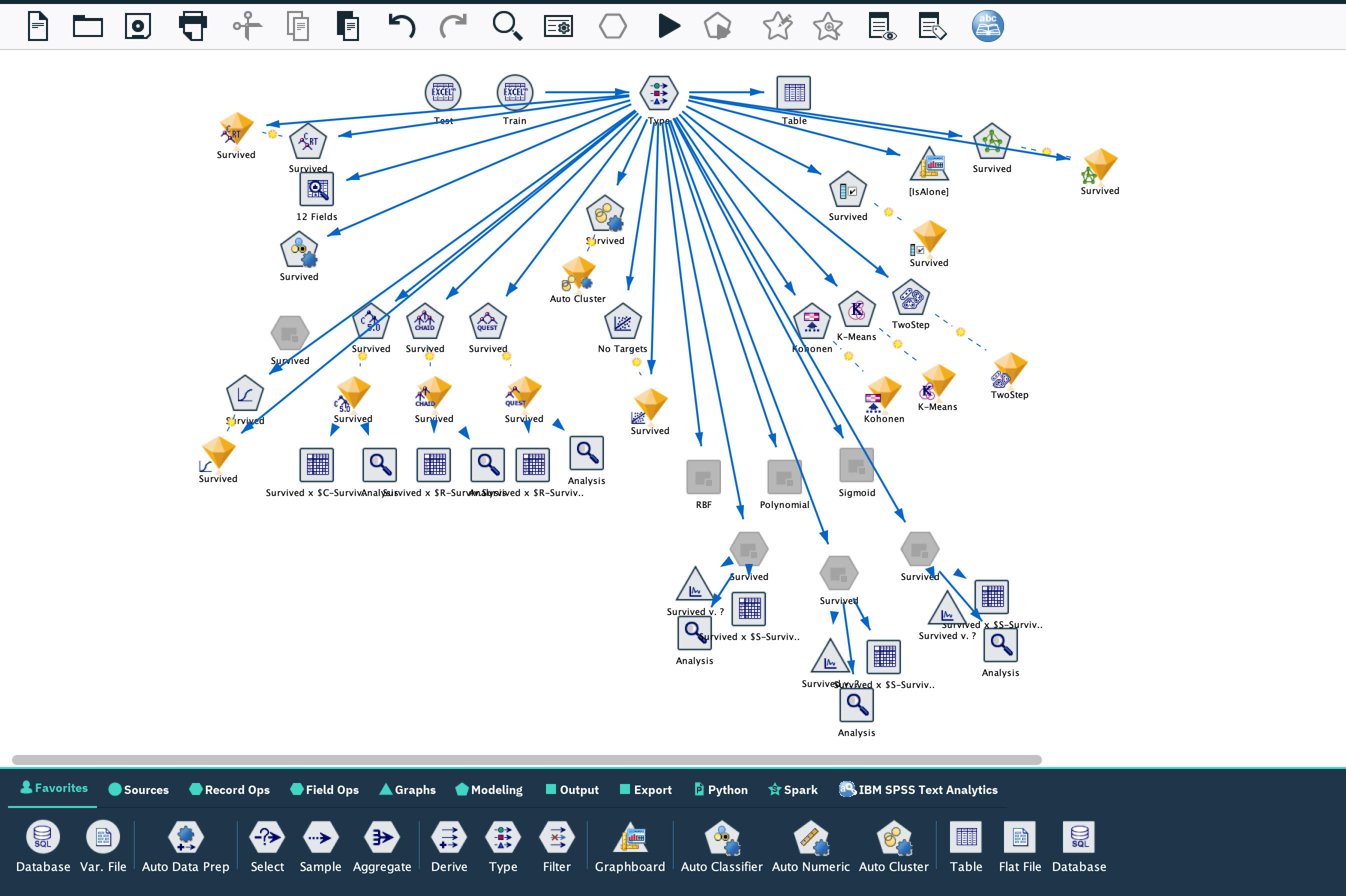
IBM SPSS Modeler stream showing multiple classification, clustering, and model-evaluation workflows connected to a shared data preparation pipeline.
Analytical Approach
Classification Modeling
Multiple supervised learning approaches were explored to predict passenger survival and compare alternative model structures.
Clustering & Segmentation
Unsupervised methods including K-Means, Kohonen, and TwoStep clustering were incorporated to explore underlying passenger groupings.
Model Comparison
Alternative modeling techniques were organized within a common workflow to support systematic comparison and evaluation.
Visual Modeling Workflow
IBM SPSS Modeler was used to connect data preparation, modeling, analysis, and output nodes within a single visual analytical pipeline.
Methods Explored
What This Project Demonstrates
Predictive Modeling
Demonstrates how multiple machine learning approaches can be developed within a common analytical workflow.
Model Evaluation
Structures alternative models so their outputs can be examined and compared systematically.
Exploratory Segmentation
Combines supervised prediction with clustering techniques to investigate patterns in the underlying data.
End-to-End Analytics
Connects data preparation, modeling, analysis, and output within a single reproducible SPSS Modeler stream.