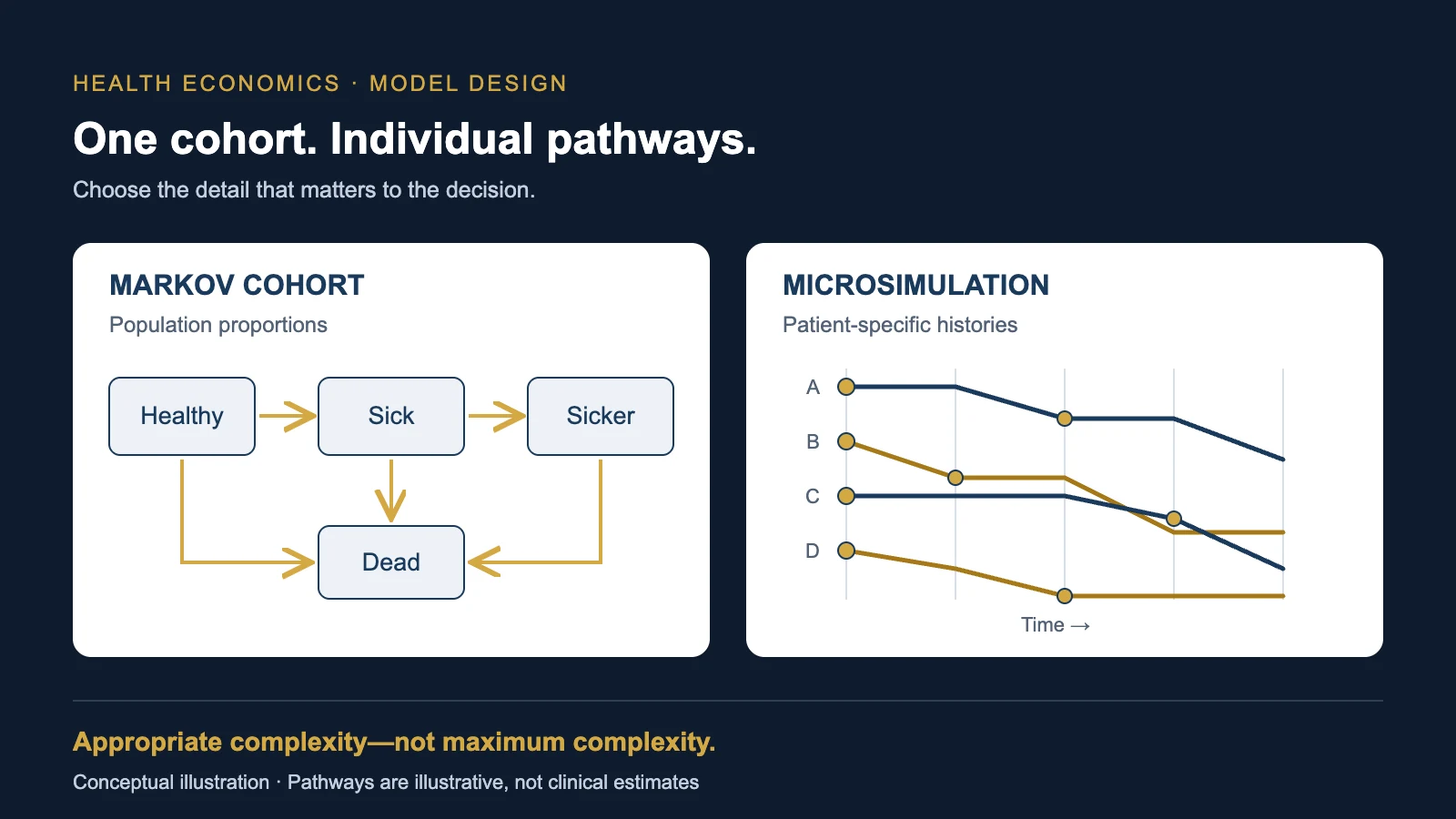
Healthcare organizations rarely have the luxury of testing every policy, treatment, or service redesign over a patient's lifetime. Decision models help estimate what could happen under competing strategies, combining evidence on clinical outcomes, costs, and uncertainty. But a modeling decision comes before the policy decision: should the analysis represent a population moving between health states, or simulate patients one at a time?
A Markov cohort model can be sufficient for many decisions. Individual-level microsimulation becomes more useful when patient history, baseline risk, or treatment response materially changes what happens next. The distinction is not simply “simple versus sophisticated.” It is whether added detail could change the decision.
What Is a Markov Cohort Model?
A Markov cohort model represents a population distributed across a defined set of health states. At each model cycle, proportions of the cohort move between states according to transition probabilities.
Consider a simplified chronic disease model with four states:
- Healthy
- Sick
- Sicker
- Dead
Patients may progress from Healthy to Sick, from Sick to Sicker, or from any living state to Dead, depending on the model's permitted transitions.
The model tracks the proportion of the population in each state over time.
For example, imagine 1,000 patients beginning in the Healthy state.
After one year, a hypothetical model estimates:
| Health State | Patients |
|---|---|
| Healthy | 850 |
| Sick | 100 |
| Sicker | 30 |
| Dead | 20 |
| Total | 1,000 |
These numbers are illustrative and do not represent clinical estimates from Krijkamp et al.
The model can attach costs and health utilities to each state, allowing analysts to estimate expected costs, life-years, and quality-adjusted life-years (QALYs).
A cohort model is particularly useful when the health-state structure captures the clinically important differences between patients.
What Is Patient-Level Microsimulation?
Patient-level microsimulation models individuals rather than moving an entire cohort through aggregate state proportions.
Each simulated patient can have characteristics such as:
- Age
- Sex
- Baseline disease severity
- Comorbidities
- Treatment assignment
- Prior clinical events
- Time spent in a particular health state
The model follows each patient's simulated pathway over time.
One patient may remain healthy for several years before developing a disease.
Another may progress rapidly through multiple disease states.
A third may experience an adverse event that changes future treatment response.
Microsimulation allows these individual histories to influence future transitions when the model is designed to do so.
This flexibility is particularly useful when patients with the same current health state may face different future risks because of their previous experiences.
Why Does Model Memory Matter?
A conventional Markov model assumes that future transitions depend on the current modeled state, rather than on unrepresented past history.
This is commonly called the Markov property.
Consider two patients currently classified as Sick.
Patient A entered the Sick state one month ago.
Patient B has remained in the Sick state for three years.
If the probability of progression depends on how long a patient has been sick, the two patients may have different risks despite occupying the same state.
A simple cohort model that does not track time in state may assign them the same transition probability.
Microsimulation can track duration in state and apply different transition probabilities.
However, microsimulation is not the only solution.
A cohort model can sometimes represent history by adding tunnel states, stratification, or other structural extensions.
The relevant question is whether the additional structure is necessary and practical for the decision being modeled.
The Sick-Sicker Model: A Useful Teaching Example
Krijkamp et al. (2018) present a tutorial on microsimulation modeling for health decision sciences using R.
Their work uses a Sick-Sicker model to explain how different model structures can represent disease progression and treatment effects.
The tutorial examines features such as:
- Individual patient heterogeneity
- Time-dependent transition probabilities
- State-residence time
- Treatment effects
- Costs and health outcomes
- First-order and second-order uncertainty
The paper provides a useful methodological foundation because it demonstrates how simulation structure can become more complex as additional assumptions are introduced.
It does not establish that microsimulation is universally preferable to cohort modeling.
Instead, it illustrates circumstances in which individual-level simulation can represent important features of the decision problem.
Reference:
Krijkamp EM, Alarid-Escudero F, Enns EA, Jalal HJ, Hunink MGM, Pechlivanoglou P.
Microsimulation modeling for health decision sciences using R: a tutorial.
Medical Decision Making. 2018;38(3):400–422.
Original scholarly paper: DOI 10.1177/0272989X18754513
When Can a Cohort Model Be Sufficient?
A cohort model can be appropriate when:
- Patients within a modeled state have sufficiently similar transition risks.
- Relevant heterogeneity can be represented through manageable subgroups.
- Disease history does not materially change future outcomes beyond what the model captures.
- The decision concerns expected population-level outcomes.
- The simpler structure provides adequate accuracy for the decision.
Cohort models can offer practical advantages.
They are often computationally efficient, easier to inspect, and simpler to communicate.
They can also support probabilistic sensitivity analysis and cost-effectiveness evaluation.
A simpler model should not be dismissed merely because it does not simulate individuals.
When Does Microsimulation Become More Useful?
Microsimulation becomes particularly valuable when individual differences materially affect future outcomes.
1. Patient Heterogeneity
Treatment effectiveness may differ by age, disease severity, or other patient characteristics.
A microsimulation can assign characteristics to individual patients and allow those characteristics to influence outcomes.
2. Disease History
Previous events may affect future risks.
For example, the number of prior complications or time spent in a disease state may influence subsequent progression.
3. Treatment Switching
Patients may change treatments depending on response, adverse events, or disease progression.
Individual-level simulation can represent these conditional treatment pathways.
4. Competing Risks
Patients may face several possible events, including disease progression, treatment complications, and death.
The model must represent these risks consistently.
5. Complex Economic Outcomes
Costs and utilities may depend on individual histories rather than only current health states.
Microsimulation can accumulate these outcomes over simulated patient trajectories.
These capabilities introduce flexibility, but they also increase implementation and validation requirements.
Markov Cohort Models vs. Microsimulation
| Decision Criterion | Markov Cohort Model | Patient-Level Microsimulation |
|---|---|---|
| Unit of analysis | Population proportions | Individual simulated patients |
| Patient heterogeneity | Requires stratification or extensions | Can represent individual characteristics |
| Disease history | Requires additional model structure | Can track individual histories |
| Time in state | Can use tunnel states | Can track duration directly |
| Computational burden | Often lower | Often higher |
| Transparency | Often easier to inspect | Requires additional validation |
| Economic evaluation | Supports costs and QALYs | Supports costs and QALYs |
| Best use case | Relatively simple population-level decisions | Decisions involving meaningful individual variation |
Neither approach is automatically more accurate.
Model quality depends on whether the structure, evidence, assumptions, and validation are appropriate.
A Worked Cost-Effectiveness Example
Consider two hypothetical treatments for a chronic condition.
Treatment A is the current standard of care.
Treatment B is a new intervention.
Assume a decision model produces the following expected lifetime outcomes per patient:
| Outcome | Treatment A | Treatment B |
|---|---|---|
| Expected lifetime cost | $45,000 | $58,000 |
| Expected QALYs | 8.20 | 8.65 |
These values are entirely hypothetical.
They are not taken from Krijkamp et al. and do not represent actual clinical evidence.
Step 1: Calculate Incremental Cost
Incremental Cost = Cost B - Cost A
$58,000 - $45,000 = $13,000
Step 2: Calculate Incremental QALYs
Incremental QALYs = QALYs B - QALYs A
8.65 - 8.20 = 0.45
Step 3: Calculate the ICER
ICER = Incremental Cost / Incremental QALYs
$13,000 / 0.45 = $28,888.89 per QALY gained
The incremental cost-effectiveness ratio is approximately:
$28,889 per QALY gained.
Step 4: Calculate Incremental Net Monetary Benefit
Suppose the decision-maker uses a hypothetical willingness-to-pay threshold of $50,000 per QALY.
Incremental Net Monetary Benefit:
INMB = (Threshold × Incremental QALYs) - Incremental Cost
INMB = ($50,000 × 0.45) - $13,000
INMB = $22,500 - $13,000
INMB = $9,500 per patient.
Under the assumed threshold and model outputs, Treatment B has positive incremental net monetary benefit.
This does not establish that Treatment B is clinically superior or should be adopted in a real healthcare system.
The conclusion depends on the validity of the clinical evidence, model assumptions, costs, utilities, uncertainty, and decision context.
Would Microsimulation Change This Decision?
The previous calculation could come from either a cohort model or a microsimulation.
The ICER alone does not reveal which modeling approach is necessary.
Suppose Treatment B is particularly effective for patients with severe disease but offers little additional benefit for patients with mild disease.
A cohort model using average treatment effects may conceal important variation.
A stratified cohort model might address that problem.
Alternatively, a microsimulation could model individual severity and treatment response.
The analyst should compare whether the added complexity materially changes:
- Expected costs
- Expected QALYs
- Incremental net monetary benefit
- Subgroup conclusions
- Uncertainty
- The preferred treatment strategy
If the results remain stable under a simpler model, microsimulation may provide limited additional decision value.
If individual histories or characteristics materially change the recommendation, the more complex structure may be justified.
First-Order vs. Second-Order Uncertainty
Krijkamp et al. distinguish two important sources of uncertainty.
First-Order Uncertainty
First-order uncertainty reflects random variation in simulated patient experiences.
Even patients with identical modeled characteristics may experience different outcomes.
For example, one patient may progress to a more severe disease state while another remains stable.
Microsimulation represents this variation through stochastic patient trajectories.
Increasing the number of simulated patients can reduce Monte Carlo error in estimated expected outcomes.
Second-Order Uncertainty
Second-order uncertainty concerns uncertainty in model parameters.
Examples include:
- Transition probabilities
- Treatment effects
- Costs
- Utility values
These parameters are estimated from imperfect evidence.
Probabilistic sensitivity analysis can represent parameter uncertainty by drawing values from appropriate probability distributions.
Increasing the number of simulated patients does not eliminate uncertainty about the true parameter values.
The distinction matters because simulation randomness and evidence uncertainty require different analytical treatment.
Why More Simulated Patients Do Not Automatically Mean Better Evidence
A microsimulation might simulate 10,000, 100,000, or one million patients.
A larger simulated population can improve numerical precision by reducing Monte Carlo error.
However, it cannot repair incorrect assumptions.
If transition probabilities are biased, simulating more patients produces a more precise estimate under the biased model.
If the model omits an important clinical event, increasing simulation size does not solve the structural problem.
If treatment effects are poorly estimated, a large simulation does not create better clinical evidence.
Model validity matters more than the apparent size of the simulated population.
How Should a Healthcare Microsimulation Be Validated?
A defensible model requires several layers of validation.
Conceptual Validation
Does the model structure represent the clinical decision problem appropriately?
Are the relevant health states, transitions, treatment pathways, and outcomes included?
Technical Verification
Does the implementation behave as intended?
Are transition probabilities valid?
Are costs and QALYs accumulated correctly?
Are absorbing states handled appropriately?
Do simulated pathways follow the specified rules?
Internal Validation
Can the model reproduce expected patterns and benchmark calculations?
Do simplified scenarios produce predictable results?
External Validation
Where appropriate evidence exists, do model predictions align with relevant external observations?
Disagreement requires investigation rather than automatic recalibration.
Sensitivity Analysis
How do results change when uncertain parameters and structural assumptions vary?
A robust decision should not depend on an unexplained or implausibly narrow set of assumptions.
A Practical Model-Selection Framework
Before choosing microsimulation, analysts should answer six questions.
| Question | Why It Matters |
|---|---|
| What decision will the model inform? | Defines the required outputs |
| Is patient heterogeneity important? | Determines whether subgroup differences matter |
| Does disease history affect future risk? | Identifies the need for model memory |
| Can a cohort model represent these features? | Tests whether simpler alternatives are adequate |
| Is sufficient evidence available? | Prevents unsupported complexity |
| Could added detail change the recommendation? | Evaluates decision relevance |
The final question is especially important.
A model can become substantially more complicated without improving the decision.
The goal should be appropriate complexity, not maximum complexity.
How Does Microsimulation Connect to Value of Information?
Once the model structure is selected, decision-makers may still face uncertainty about key parameters.
For example:
How effective is the new treatment?
How long does its benefit last?
What is the probability of disease progression?
How much does treatment cost over a patient's lifetime?
These uncertainties may influence the preferred strategy.
Value-of-information analysis can estimate whether additional research could improve the decision enough to justify its cost.
Expected Value of Perfect Information measures the maximum expected decision improvement from resolving relevant uncertainty perfectly.
Expected Value of Sample Information evaluates the expected benefit of a specific proposed study or information source.
These concepts complement simulation modeling.
Microsimulation estimates consequences under specified assumptions.
Value-of-information analysis helps determine whether reducing uncertainty about those assumptions is economically worthwhile.
What Should Decision-Makers Request From an Analytics Team?
Rather than asking for “the most advanced model,” ask for a short model-selection memo:
What decision will the model inform?
What simpler model was considered?
Which patient differences or histories might change the decision?
What evidence supports them?
How will uncertainty and validation be handled?
What outputs will decision-makers actually use?
For a hospital, payer, or health-technology team, the useful deliverable is not a simulation file alone.
It is a transparent comparison of strategies, expected costs and health outcomes, the drivers of those estimates, and the conditions under which the recommendation changes.
Bottom Line: Complexity Should Follow the Decision
A Markov cohort model is often a strong starting point for population-level economic evaluation.
Microsimulation earns its place when individual heterogeneity, event history, or path-dependent outcomes are important to the choice and cannot be represented adequately in a simpler structure.
The most defensible workflow is to define the decision, build a parsimonious baseline, test whether omitted complexity changes conclusions, and validate any added detail.
Better decision modeling is not about simulating more patients or writing more code. It is about representing the differences that matter.
Reference and Methodological Note
Krijkamp EM, Alarid-Escudero F, Enns EA, Jalal HJ, Hunink MGM, Pechlivanoglou P.
Microsimulation modeling for health decision sciences using R: a tutorial.
Medical Decision Making. 2018;38(3):400–422.
DOI: https://doi.org/10.1177/0272989X18754513
The conceptual distinction, Sick-Sicker example, first-/second-order uncertainty discussion, and R implementation are drawn from Krijkamp et al.
The model-selection checklist and all numerical cost-effectiveness calculations in this article are original hypothetical illustrations.
They are not estimates from the cited study and should not be used to make clinical or reimbursement decisions without a context-specific evaluation.
Explore Health Economics and Decision Modeling
Healthcare decision models are most useful when their structure, assumptions, and uncertainty are aligned with the decision they are intended to support.
UAD Consulting explores cost-effectiveness analysis, Markov models, microsimulation, sensitivity analysis, and decision-focused healthcare analytics.
Explore our healthcare analytics and decision-modeling services, or get in touch to discuss your project.
Explore ServicesGet in Touch